
bluetronix History
Content Management since 2002
The bluetronix CMS was released on February 20, 2020, in CMS version 1.1 as a commercial customer management system including a hosting package. Since then, the system has been continuously developed – from a compact CMS solution to comprehensive enterprise solutions. From the very beginning, development has been closely linked to real customer projects: The bluetronix CMS was deployed directly in customer projects and further enhanced in collaboration with them. This allowed us to gain valuable practical experience – particularly regarding which features customers can use independently, how software needs to be designed to be intuitive, and what additional services are essential for larger projects. The entire development is thus consistently based on practical requirements from real customer projects.
Chronology
bluetronix 1
Version 1.1 - Content Editing - Wysiwyg Editor
With version 1.1, bluetronix started as a very lean system for content maintenance. Initially, a simple text editor was at the center, allowing predefined HTML pages to be opened, edited, and saved via a button. The functions focused on basic formatting such as bold, italic, underlined, and simple text alignment. The goal of this first version was clear: customers should be able to change content themselves without having to touch the source code – reliably, quickly, and without technical hurdles.
This approach was unusual for its time, as many systems were either purely static or completely technical. bluetronix positioned itself early on as a website tool for non-technical users.
In 2002, bluetronix ranked first on Google in English-speaking regions for the keyword "Website Editor."
Version 1.2 – Advanced Text Formatting
With version 1.2, the text editor was specifically expanded. New features such as fonts, heading levels, and text colors were added. The focus was on not just maintaining content but also being able to stylistically influence it without needing HTML knowledge.
Thus, bluetronix was already moving early towards a visual content editor, long before WYSIWYG editors became the standard.
Version 1.3 – Structured Content
With version 1.3, the system was structurally expanded for the first time. Tables could be inserted, as well as defined page sections that could be specifically placed and exchanged. This led to a modular page structure that clearly separated and made content reusable.
This version marked the transition from a pure text editor to a true content management system.
bluetronix 2
Version 2.0 – CMS & Navigation
With version 2.0, a fundamental architectural change occurred. Users could now create their own pages, link them together, and create navigation. Websites no longer consisted of individual edited pages but a structured page hierarchy.
Internally, pages were no longer stored as pure HTML files but managed via database entries. The HTML page was subsequently dynamically composed from the database entries for the header, main, and footer.
Additionally, the system became multi-user capable for the first time. Up to five editors could work on a website simultaneously – with clearly separated rights.
Version 2.1 – File Management & Storage Management
With version 2.1, a central file manager was introduced. Images, documents, and other files could be uploaded, organized, and reused. This was supplemented by a storage management feature that transparently displayed how much space was used.
At the same time, domain and email functions were integrated. By this time, email addresses and accounts could already be created and managed for a domain.
bluetronix 3
Version 3.0 – Domain & Email: Website and Communication in One System
With version 3, bluetronix became the platform that not only mapped website content but also email communication and settings surrounding a domain for the first time. Customers could create email addresses and manage email accounts for their registered domains. This made the system not just a website tool, but a central access point for the entire web presence – including mail structure. At the same time, the newsletter was integrated, allowing customers to manage contacts and send campaigns directly through bluetronix. Additionally, the user and rights system was revised to better represent roles and responsibilities.
Version 3.1 – Stabilization & Scaling
This phase was heavily characterized by stabilization and practical experience. Many customers were now permanently working with bluetronix, leading to numerous detailed improvements in usability, security, and performance.
Internally, a completely new server structure was established, in which customer packages could be managed automatically and backup systems were organized across various data center locations.
bluetronix 4
Version 4.0 – Databases, Statistics, Shop
With version 4, enterprise development began: bluetronix was expanded with databases for direct customer use and received its first integrated DB editor. Tables could be displayed and edited, both in table view and in record/view mode. This made it possible to manage dynamic content and structured data directly within the system. Additionally, initial statistical access evaluations were added to create a better understanding of visitor flows and usage. bluetronix evolved from a pure CMS to a platform that combines data, content, and evaluations.
Version 4.1 – Modules, Layout Editing, and Dynamic Page Logic
In the next expansion stage, central CMS functions were systematically modularized. Modules such as News, internal areas, galleries, Community, text search, calendars, and booking were created. Additionally, the ability to edit layouts within the system was introduced, bringing design and content closer together. A PHP editor was integrated for agencies and advanced projects, allowing pages to be split into an HTML part and a PHP part. This enabled static content and dynamic logic to be implemented cleanly separated – an important step for professional web applications.
Version 4.2 – Forms, Shop Processes, Payment, and App Ecosystem
With version 4, core processes that were repeatedly needed in customer projects were also implemented. A key example is the form system: users could create forms directly in the editor. Inputs could be delivered via email and were simultaneously viewable in the form archive within the system. This created traceable processes and a standardized handling – particularly for recurring inquiries.
At the same time, the first shop version was created, including order entry for processing shop orders. PayPal Plus was integrated as the payment system, making order processing significantly more professional and customer-friendly.
A particularly groundbreaking step was the first-time integration of a system for custom client apps that could retrieve content directly from the CMS. This laid the foundation for companies to not only control website content but also distribute that content in iOS and Android apps – including push notifications. Additionally, a white-label system was introduced, allowing agencies to use bluetronix with their own branding and logo as an agency CMS.
bluetronix 5
Version 5.0 – Navigation and Professional User System
With version 5, bluetronix was developed in many areas so that it could reliably scale not only for websites but also for real customer portals and enterprise workflows. An important focus was navigation: it was expanded as the central function and could be structured, maintained, and expanded in a targeted manner. This allowed for a significantly cleaner management of the entire page structure – especially for extensive projects with many subpages, language versions, or portal functions.
Additionally, a feature was integrated that allowed page content to be reviewed in a non-public view within the CMS. This content could then be specifically released for publication or automatically published at a predetermined time.
At the same time, the user system was fundamentally improved. Instead of simple roles, much finer structures became possible, such as groups, registered customers, editors, and other role profiles. This was crucial for projects where customers maintain content while internal staff administer or control other areas. bluetronix thus acquired a user logic that is not just a "website editor," but represents real access and process structures.
Version 5.1 – Database Backups, Import/Export, and Tools for Agencies
With version 5, the data and administration area was also professionalized. Database backup functions were added to reliably safeguard tables and content and to make recoveries planable – a key factor for projects that are permanently operated and where data quality is essential.
At the same time, database management was expanded with import and export functions, including via CSV and TXT, so that existing data sets (e.g., product lists, customer lists, or newsletter address databases) from other systems could be adopted. Additionally, the execution of MySQL scripts was integrated, which is especially important in agency and enterprise environments to quickly and controlled adjust database structures.
Version 5.2 – Translation, Evaluation, and Linking with External Analysis Tools
Another core area of version 5 was the connection to external systems. For website translations, automated translation through the Google Translate API was integrated – at that time an important step to quickly realize multilingualism before modern AI models could deliver significantly better results later.
At the same time, evaluations became significantly more professional: bluetronix could not only capture accesses internally but also link with external tools. This included integrations such as Google Search Console, Google Analytics, Bing Webmaster, and Alexa Webmaster. The goal was to ensure that clients and agencies do not have to search for visibility, SEO, and campaigns across ten different tools, but rather have central integration points within the system.
Version 5.3 – Webmail, Newsletter Statistics, SMS, and Clear Separation of Owner Data
With the bluetronix webmailer, one of the most important comfort features was released: Emails could now be read and written directly in the system – without an external client. This was particularly relevant for customers who wanted to centrally manage their website, domain, and communication.
Based on the developments of the own webmailer, central base modules were developed for enterprise customers. These allowed for incoming emails to be automatically accepted, programmatically evaluated, processed, and if necessary, resent. Additionally, system services could represent these emails as system events, display content, and subsequently trigger new events or processes within the system.
The newsletter has also been significantly improved: In addition to sending, statistical evaluations have been added, making open and click rates as well as link interactions visible. For enterprise customers, SMS sending has also been introduced as a standard module – ideal for system events, important notices, or time-sensitive communication.
Another essential detail in large projects: ownership data has been clearly separated, ensuring that domain owners, website owners, and billing owners are no longer mixed. This greatly simplifies agency models, client changes, billing processes, and legal information (e.g., imprint).
bluetronix 6
Version 6.0 – From Web Package to Server Model
With version 6, bluetronix was expanded so that customers could not only use classic web packages but also lease entire servers if needed. This made the system suitable for larger portals and applications where performance, availability, and system control play a central role. Additionally, features such as live checks and lock mechanisms for server customers were added to better control critical accesses.
In addition, multiple servers could be connected to form cluster systems. Modules were developed for enterprise customers that enabled distributed synchronization of databases across multiple servers.
Back Office as Enterprise Basis
A central milestone was the first-time integration of a real back office module. From this point on, processes such as customer management, quotes, invoices, reminders, payment bookings, and export of booking data and invoices could be directly represented in the system. bluetronix was no longer just a website and shop platform but began to systematically support business processes – particularly relevant for enterprise projects where content, orders, accounting, and communication must converge.
New Modules: Reviews and VR Tours
In this phase, new content and interaction forms were integrated. This included the review module for websites and shops, allowing visitors to leave reviews that can be displayed and controlled flexibly. A VR tour module was also introduced, allowing 360° images to be embedded and used as interactive tours – including links between shots and objects.
Customers could now better monitor the dedicated servers. Live checks, access locks, and infrastructure monitoring were integrated. Additional modules such as multilingual support and extra payment providers expanded the system.
A responsive preview for desktop, tablet, and smartphone was introduced, along with agency access with extended rights.
Version 6.1 – Multilingual Support, SMTP, Stripe, and Extended Statistics
To enable international and professional operation of bluetronix, the CMS was expanded in several languages, including German, English, French, and Spanish. At the same time, external SMTP servers could be connected to send system emails and newsletters reliably through professional mail infrastructures.
For the shop area, Stripe was integrated as a credit card payment system. In the statistics area, further evaluations were added: separate evaluations for ad accesses, online visitors, individual accesses, and extended detailed analyses. Additionally, a responsive preview for desktop, tablet, and smartphone was built in to check websites and portals directly in the CMS in different views.
Agencies also received a clearly integrated agency access to professionally prepare projects for clients, manage layouts, and implement technical adjustments cleanly.
bluetronix 7
Version 7 – Responsive System, Modern Templates, and Live Views
With version 7, bluetronix was comprehensively modernized. The CMS itself and all page templates were fully implemented responsively and integrated with Bootstrap 4. This allowed websites and portals to be optimized not only for mobile devices but also made it significantly easier to ensure consistent design – especially for larger customer projects with many templates and page types.
The layout templates were expanded with live views, allowing changes to be much better traceable. At the same time, the database functions were expanded, including through views, which significantly improved dynamic evaluations and structured data access in projects.
Version 7.1 – Publication and Finer Backups
An important step for professional workflows was the change in the publication model: Websites now start in an unpublished version by default, allowing changes to be internally reviewed before going live. This reduces errors, facilitates teamwork, and creates a clear separation between draft and production.
The backup system was also divided into separate areas: pages, databases, and layouts could be backed up and restored independently. This made the system significantly more robust – especially in agency setups where design, content, and data work are done in parallel.
Version 7.2 – First AI Functions
In this development phase, the first AI functions were integrated, initially mainly where it was sensible and technically realistic: website translations and supporting automations. Importantly, these AI functions only became possible when corresponding external interfaces were available and economically usable. bluetronix has thus embedded AI not as an "experiment" but as a real product function into existing workflows.
bluetronix 8
Integrated Platform & AI Extensions
With version 8, bluetronix was fundamentally modernized again. Bootstrap 5 was integrated, and page templates were revised and made significantly more flexible. Systematic color sets and font sets were introduced to facilitate consistent design across entire projects – especially in corporate designs.
The domain management has been further professionalized: domains can now be managed live, subdomains can be created, and language versions can be assigned to specific domains. This is especially important for international projects where language versions are to be treated as standalone websites.
Order store, templates for email/newsletters, and central management
The order store has created a central function for systematically commissioning and processing additional services. Customers can submit requests, receive offers, and track implementation centrally – without email chaos and without a media break. Alongside this, email layouts for the webmail client, newsletter layouts, and an extended newsletter management have been introduced to make communication more professional and consistent.
Dark mode, 24 languages, modular overhaul, and credits
In version 8, dark mode was also introduced and expanded throughout the system. The CMS can be used in dark or light mode, and later central areas like search, login, and other UI elements will also be included. Additionally, the system has been expanded to 24 languages – important for international customers and teams.
Many modules have been fundamentally revised, modernized, and standardized. For AI-related functions, credits have been introduced as a credit model, allowing for clear calculation and flexible use of AI functions.
Chat, support chat, and customer communication within the system
Another focus was the integration of a chat module: website owners can communicate directly with visitors or customers. Additionally, a 24-hour support chat has been integrated, so support and customer communication no longer have to occur through external channels, but can be done directly within the system.
Version 8.1 – bluetronix app, system push, project management
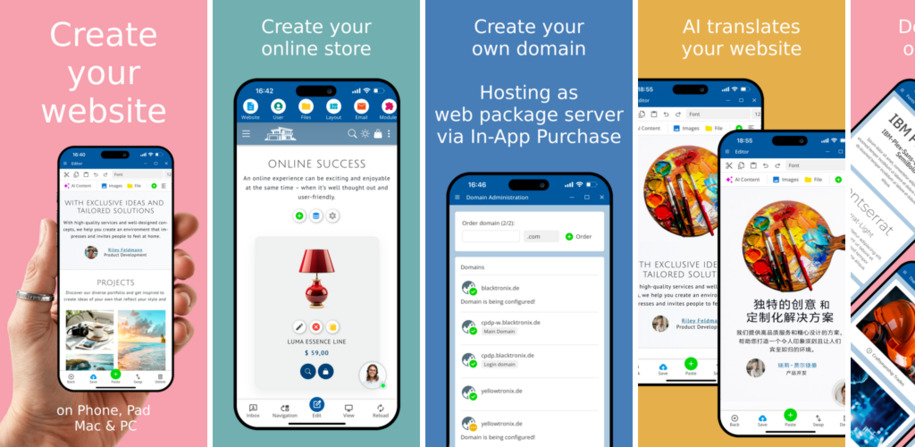
A central expansion was the release of the bluetronix app for iOS and Android. This allows projects to be managed not only on PCs but also on smartphones and tablets. System push notifications can now be used as a real communication channel – both for internal events and customer communication.
Additionally, a project management system specifically designed for app access has been integrated. This allows projects to be managed on the go, status checked, and content/requests centrally controlled – a major advantage in real operational and agency workflows.
Expansion of AI functions, new modules
With modern AI integration, AI translations, AI image generators, and AI-supported database and content functions have been integrated. Modules such as sales funnel, chat, support chat, order store, dark mode (CMS & website), credits system, and agency white-label have been extensively expanded and continuously developed.
FAQ
what customers often ask us
Was bluetronix around before WordPress?
Yes. bluetronix started in 2002 as a website editor and gradually developed into a full-fledged CMS and later transformed into a platform. WordPress appeared in 2003 and was primarily known as a blogging system in its early years.
Was bluetronix a proper CMS from the beginning?
No. The early versions (from 2002) were intentionally lean and focused on simple content editing. The transition to a true CMS began in 2004 with structured content and was fully developed into a complete CMS in 2005 with navigation, page hierarchy, and database management.
What was the core idea of the first bluetronix versions?
Content should be changeable by customers themselves without needing to touch the source code. The focus was on a reliable editor that covers typical formatting and simplifies website maintenance – quickly, stably, and without technical barriers.
Since when does bluetronix have enterprise projects?
Enterprise development began with version 4 (2009). During this phase, functions such as databases, a DB editor, and evaluations were added to professionally represent larger, data-driven projects. In subsequent versions, modules, layout editing, workflows, and back-office processes were further developed.
Since when can multiple users work on a website simultaneously?
Since version 2.0 (2005), bluetronix has been multi-user capable. Even then, multiple editors could edit content in parallel – with separate permissions. Later, the system was enhanced with finer roles, groups, and extended user logic for portals and agencies.
Since when does bluetronix manage domains and email directly in the system?
Domain and email functions were integrated starting in 2006 and significantly expanded with version 3 (2007). This made bluetronix a platform that consolidates website, domain management, and email communication in one system – including newsletter functions.
Why is bluetronix less known than WordPress?
WordPress is a freely available open-source CMS that is continuously developed, promoted, and used by thousands of developers, agencies, and communities worldwide. Due to its free usage, widespread adoption among hosts, and the vast number of themes and plugins, WordPress has grown rapidly and is the first point of contact with a CMS for many users.
In contrast, bluetronix is a commercial CMS that is solely developed and maintained by bluetronix itself. The focus is not on maximum distribution but on stable, integrated systems, clear workflows, security aspects, and long-term maintainability. Since the system is paid and only distributed in combination with a bluetronix web package or server, its recognition is naturally lower than that of a free, community-driven system like WordPress.
Since when are there AI functions in bluetronix?
The first AI functions were introduced in 2023 (version 7.2), initially for translations and supporting automations. With version 8, AI functions were expanded more broadly, including for content, images, and additional workflows in the system.
Web Package
from 29.99 € per month
Everything you need for your web presence.
- ✓ Own Domain
- ✓ Email inboxes matching the domain
- ✓ Web space or server
- ✓ bluetronix web software + website builder app
- ✓ Modern, responsive HTML5 website template
- ✓ Many modules and functions
No setup costs. Expandable at any time.
Ready to go instantly
Customize design, fill page content with AI, register domain, publish – done.